

Increasing revenue in eCommerce doesn’t always require more traffic. In many cases, the easier win is getting customers to spend a bit more during each purchase.
This is exactly what Average Order Value (AOV) measures. If your store’s AOV grows from €50 to €60, that’s a 20% revenue increase without a single new visitor.
The challenge is simple: most customers buy only what they originally came for. They add one product to the cart and head straight to checkout.
Product bundles change that behavior.
Instead of selling items individually, bundles group multiple products into a single offer. This makes it easier for customers to justify spending more, often without feeling like they’re overspending.
A well-structured bundle doesn’t just increase cart value. It makes the purchase feel more complete, more convenient, and often more valuable than buying products separately.
In this guide, we’ll break down why product bundles work, how they increase average order value, and how to implement them effectively in WooCommerce.
What Are Product Bundles?
Product bundles are offers where multiple products are grouped together and sold as a single package.
Instead of buying items individually, customers get a combined deal that feels more convenient and often more valuable.
Common examples include:
- “Buy 3 for €25”
- Starter kits (e.g. skincare set, coffee bundle)
- Frequently bought together products
- Product + accessory combinations
The key idea is simple: encourage customers to buy more items in one decision instead of multiple smaller decisions.
This is what separates bundles from standard discounts.
A regular discount lowers the price of a single product.
A bundle increases the total order value by adding more products to the cart.
For example:
- Discount: One product from €20 → €15
- Bundle: Three products for €45 instead of €60
In the first case, revenue per order drops.
In the second case, order value increases while still offering a perceived deal.
Keep in mind: Bundles don’t have to be heavily discounted to work. Even small savings or added convenience can be enough to push customers toward a larger purchase.
Why Product Bundles Increase AOV
Product bundles work because they align with how people naturally make buying decisions. Instead of analyzing each item separately, customers evaluate the bundle as a whole.
That shift changes how value is perceived.
Higher perceived value
When multiple products are grouped together, the offer feels more substantial. Even a small discount across several items creates the impression of a better deal.
A bundle priced at €50 for three items often feels more attractive than buying each item individually for €18–€20, even if the savings are modest.
Reduced decision friction
Choosing one product is easy. Choosing three separate products takes effort.
Bundles remove that friction.
Instead of asking:
“Which of these should I buy?”
The bundle answers:
“Here’s everything you need.”
Fewer decisions lead to faster checkouts and higher cart values.
Encourages spending beyond the original intent
Most customers enter a store with a rough budget in mind.
Bundles stretch that budget naturally.
Someone planning to spend €30 may accept a €45 bundle if it feels like a complete solution or a better overall deal.
Price anchoring effect
Bundles make individual prices less important.
When customers see:
- Product A: €20
- Product B: €20
- Product C: €20
- Bundle: €50
The bundle becomes the reference point.
Instead of thinking “€50 is expensive,” they think “I’m saving €10.”
Important: Bundles shift the focus from price to value. That’s why they increase AOV without relying on aggressive discounts.
Types of Product Bundles That Work
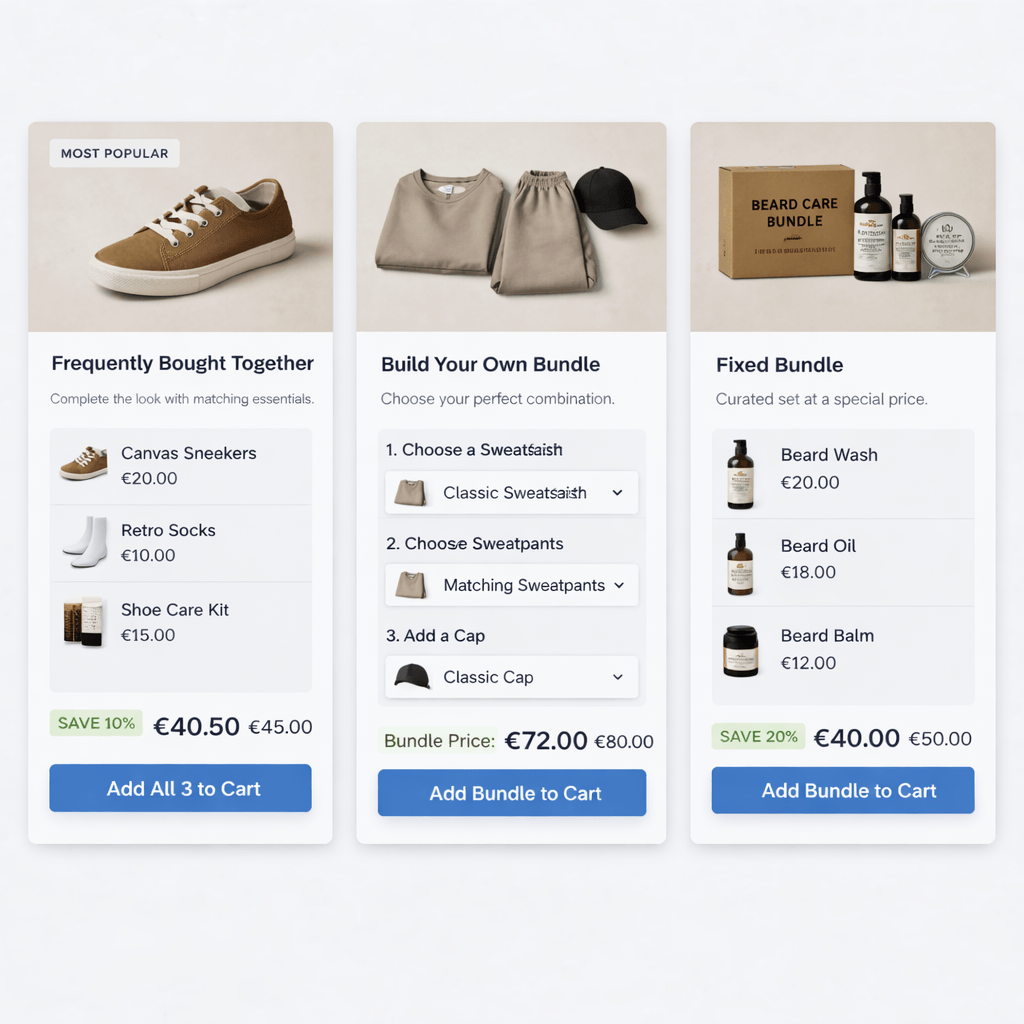
Not all bundles perform the same. The structure of the bundle has a direct impact on how customers perceive value and how much they’re willing to spend.
These are the most common types that consistently increase average order value.
Pure bundles (fixed sets)
A fixed bundle includes a predefined group of products sold together.
Examples:
- Skincare routine set
- Coffee starter pack (beans + grinder + filters)
- Gym essentials bundle
This works best when products naturally belong together.
The advantage is simplicity. Customers don’t need to think — the bundle already makes sense.
Mix & match bundles
Customers choose items within a predefined rule.
Examples:
- Pick any 3 for €30
- Choose 5 items and get 15% off
- Build your own box
This gives flexibility while still pushing higher quantities.
It works especially well for:
- Apparel
- Food & beverages
- Cosmetics
Volume bundles
These focus on buying more of the same product.
Examples:
- Buy 2, get 10% off
- Buy 3, save €5
- Family packs or bulk pricing
This is one of the simplest ways to increase AOV, especially for consumables.
Cross-sell bundles
Different but complementary products grouped together.
Examples:
- Laptop + mouse + bag
- Shoes + care kit
- Camera + memory card
This increases AOV while also improving the overall customer experience.
Instead of forgetting an accessory and coming back later, customers complete the purchase in one go.
Keep in mind: The best-performing bundles are the ones that feel logical. If customers have to think “why are these products together?”, the bundle will likely fail.
Real Example: AOV Impact of Bundling
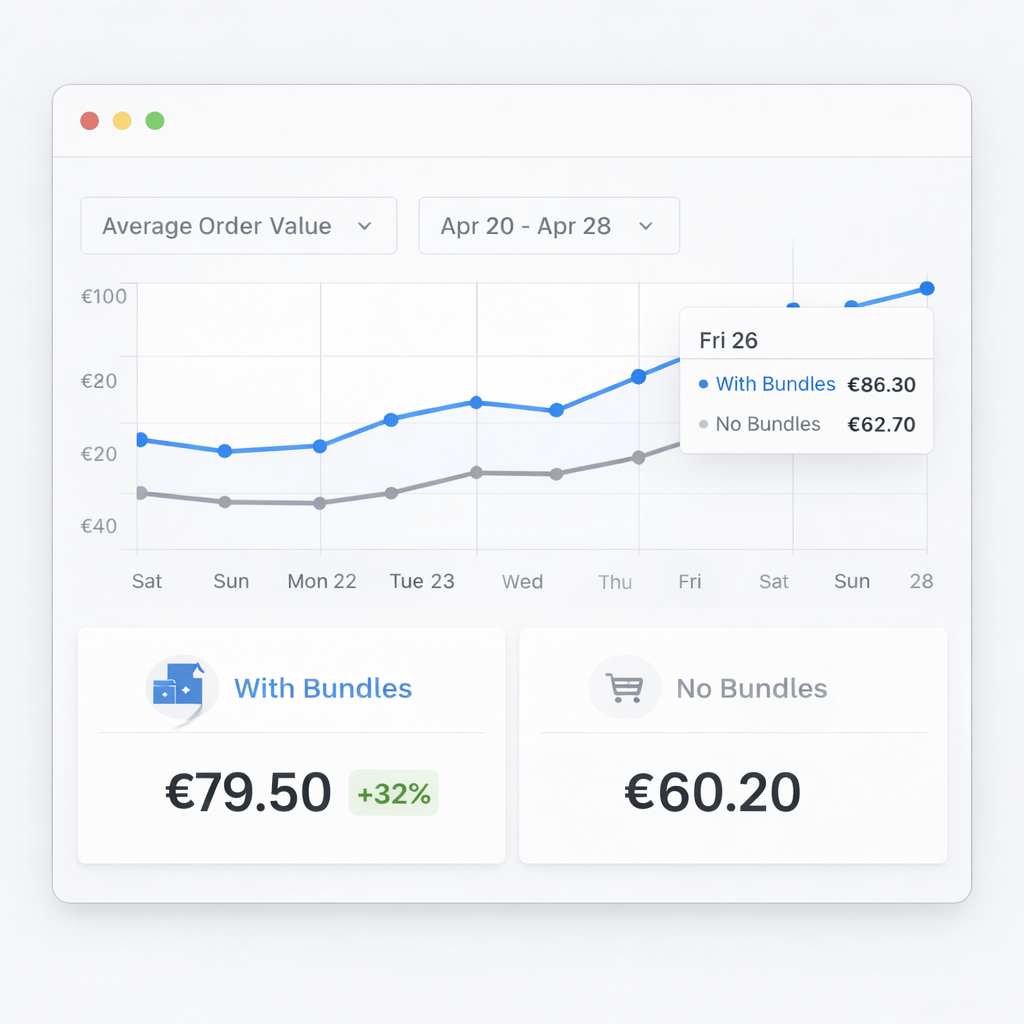
Let’s keep it simple and realistic.
Assume your current situation:
- Average Order Value: €40
- Typical purchase: 1–2 products
- Gross margin: 40%
Now you introduce a bundle:
- Individual products: €20 each
- Bundle: 3 products for €50
Without bundles
Customer buys 2 products:
- Order value: €40
- Profit (40%): €16
With bundles
Customer chooses the bundle:
- Order value: €50
- Profit (40%): €20
That’s a 25% increase in revenue per order and €4 more profit, from the same customer, with no additional marketing cost.
Now scale that.
If you have 1,000 orders per month:
- Without bundles: €40,000 revenue
- With bundles: €50,000 revenue
That’s €10,000 additional revenue just by changing how products are offered.
Important: You didn’t increase traffic. You didn’t improve conversion rate. You simply increased the value of each order.
This is why bundles are powerful. They optimize existing buying intent instead of trying to create new demand.
How to Implement Product Bundles in WooCommerce
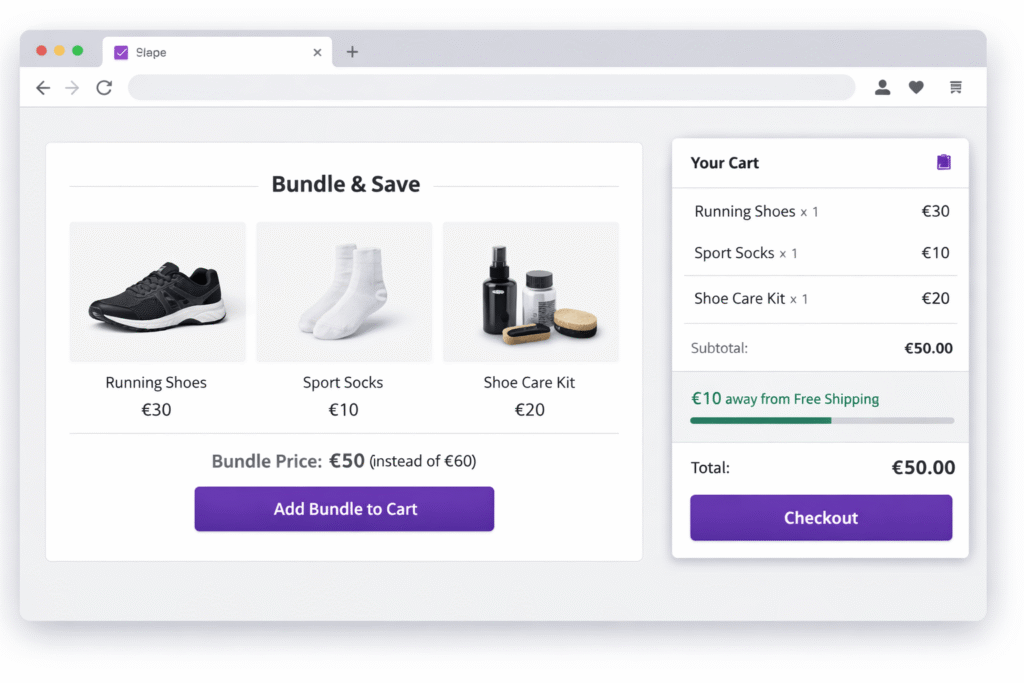
Creating bundles is not just about grouping products together. The way you present and position them has a direct impact on how well they perform.
Choose the right bundle structure
Start with the simplest option that fits your products.
- Fixed bundles → best for curated sets
- Mix & match → best for variety-heavy stores
- Volume bundles → best for consumables
- Cross-sell bundles → best for accessories
Avoid overcomplicating it. If customers need instructions to understand the offer, it’s already too complex.
Make bundles visible at the right moment
Bundles should appear when customers are most likely to add more items.
Key placements:
- Product page (primary location)
- Cart page (last chance to increase value)
- Mini cart or slide-out cart
If bundles are hidden or hard to find, they won’t affect AOV.
Keep pricing clear and transparent
Customers should instantly understand:
- what’s included
- how much they save
- the final price
Avoid vague messaging like “special offer” without numbers.
Clear example:
“3 for €50 (save €10)”
Clarity converts. Confusion kills conversions.
Combine bundles with free shipping thresholds
Bundles become even more effective when paired with a free shipping goal.
Example:
- Free shipping at €60
- Bundle priced at €50
Customer is now very close to unlocking free shipping and is likely to add one more item.
This creates a natural progression:
bundle → slightly higher cart → free shipping
Implementation tip: One practical way to reinforce this is by showing customers how close they are to free shipping directly in the cart. A small dynamic progress indicator can make that gap visible and encourage adding one more product. Some WooCommerce stores use tools like Free Shipping Label to display this automatically as the cart value updates.
Test and adjust
Not every bundle will work immediately.
Test:
- different price points
- number of items
- product combinations
Even small changes can significantly affect performance.
Keep in mind: Bundles are not a one-time setup. The best results come from refining them based on actual customer behavior.
Common Mistakes to Avoid
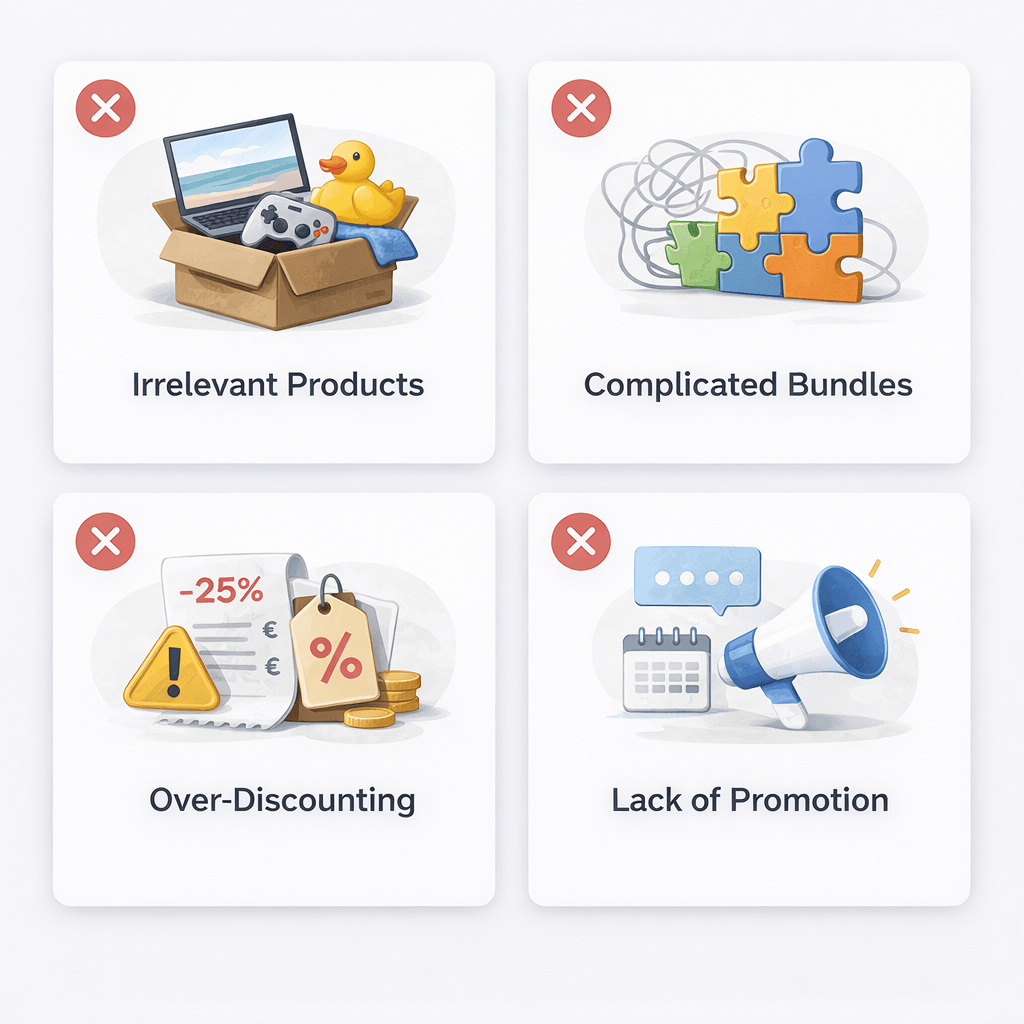
Product bundles can increase AOV quickly, but poorly structured bundles can do the opposite. Instead of boosting revenue, they can reduce margins or confuse customers.
Over-discounting
The biggest mistake is giving away too much value.
If your bundle saves €15–€20 on a €50 offer, you’re training customers to wait for deals instead of buying at full price.
A small, clear benefit is enough. The goal is to increase order value, not destroy margins.
Irrelevant product combinations
Bundles only work when they make sense.
Pairing random products together might look like a deal, but customers won’t see the value.
Bad example:
- Shoes + unrelated accessory no one needs
Good example:
- Shoes + care kit + socks
If the bundle feels logical, customers don’t question it.
Too many options
Giving customers too many bundle choices creates friction.
- 2–3 strong bundles → works
- 10 different bundles → overwhelming
More options don’t increase conversions. They slow decisions.
Confusing pricing
If customers need to calculate the savings themselves, the bundle loses impact.
Avoid:
- unclear discounts
- hidden conditions
- inconsistent pricing
Always show:
- total price
- savings
Ignoring placement
Even a great bundle won’t work if no one sees it.
If it’s buried somewhere on the page or only visible after multiple clicks, it’s useless.
Bundles should be visible where decisions are still flexible:
- product page
- cart
- mini cart
Checkout can be used, but only carefully. At this stage, the goal is to complete the purchase, not introduce complex offers. If used, it should be limited to simple, low-friction add-ons rather than full bundles.
Important: A bundle is not just a pricing tactic. It’s a UX decision. If it’s not obvious, clear, and easy to accept, it won’t increase AOV.
Conclusion
Product bundles are one of the simplest ways to increase average order value without relying on more traffic or aggressive discounting.
Instead of trying to convince more people to buy, you’re making each purchase more valuable.
A well-designed bundle:
- increases perceived value
- simplifies decision-making
- encourages customers to spend more than they initially planned
The key is keeping it logical and clear. Bundles should feel like a natural choice, not a forced offer.
Start simple.
Test one or two bundles, monitor how they affect your average order value, and adjust based on real data. Even small improvements can have a noticeable impact on overall revenue.
If combined with other strategies like free shipping thresholds, bundles become even more effective — creating a clear path for customers to increase their cart value without friction.
In the end, the goal isn’t just to sell more products. It’s to create offers that make buying more feel like the obvious decision.