Free shipping is one of the strongest incentives in eCommerce. It works not because it’s cheap for the store, but because it feels valuable to the customer.
But simply offering free shipping isn’t enough.
The real impact comes from how you set the threshold.
Set it too low, and you eat into your margins.
Set it too high, and customers ignore it completely.
Many stores make the same mistake — they pick a number that “sounds right” or copy competitors without understanding their own data.
That approach rarely works.
In this guide, you’ll learn how to set a free shipping threshold that actually increases sales and average order value — using simple calculations, real examples, and practical strategies you can apply immediately.
Why Free Shipping Thresholds Work (Psychology Behind It)
Free shipping works because it changes how customers perceive value.
Shipping feels like an extra cost — something that doesn’t add value to the product. When customers see a €5–€10 shipping fee at checkout, it often creates friction and hesitation.
But when free shipping is within reach, that perception shifts.
Instead of thinking “this costs extra”, customers start thinking:
“I’m only €8 away from getting free shipping.”
That small shift is powerful.
It creates a clear, achievable goal. And once a customer is already in buying mode, reaching that goal often feels easier than abandoning the purchase.
Important: Free shipping thresholds don’t just reduce friction — they actively increase cart value.
Customers are no longer deciding whether to buy.
They’re deciding how much more to add.
That’s why a well-placed threshold can significantly increase Average Order Value (AOV) without increasing traffic or conversion costs.
The Biggest Mistake: Setting a Random Threshold
One of the most common mistakes is setting a free shipping threshold without any real logic behind it.
Many stores choose a number that “feels right” — like €50 or €100 — or simply copy what competitors are doing. The problem is, that number might have nothing to do with your pricing, margins, or customer behavior.
This leads to two common issues:
- Threshold too low → customers qualify too easily, and you absorb the shipping cost without increasing order value
- Threshold too high → customers ignore it completely because it feels unrealistic
Neither scenario improves profitability.
Here’s a simple example:
- Store A has an average order value of €48
- They set free shipping at €50
This works. Most customers are already close, so adding one small item feels easy.
Now compare that to:
- Store B also has an AOV of €48
- They set free shipping at €80
In this case, the gap is too large. Customers don’t feel motivated — they either ignore the threshold or abandon the cart.
Important: A free shipping threshold should feel close enough to reach, but high enough to increase order value.
Anything else is just guesswork — and guesswork rarely converts.
The Data You Need Before Setting a Threshold
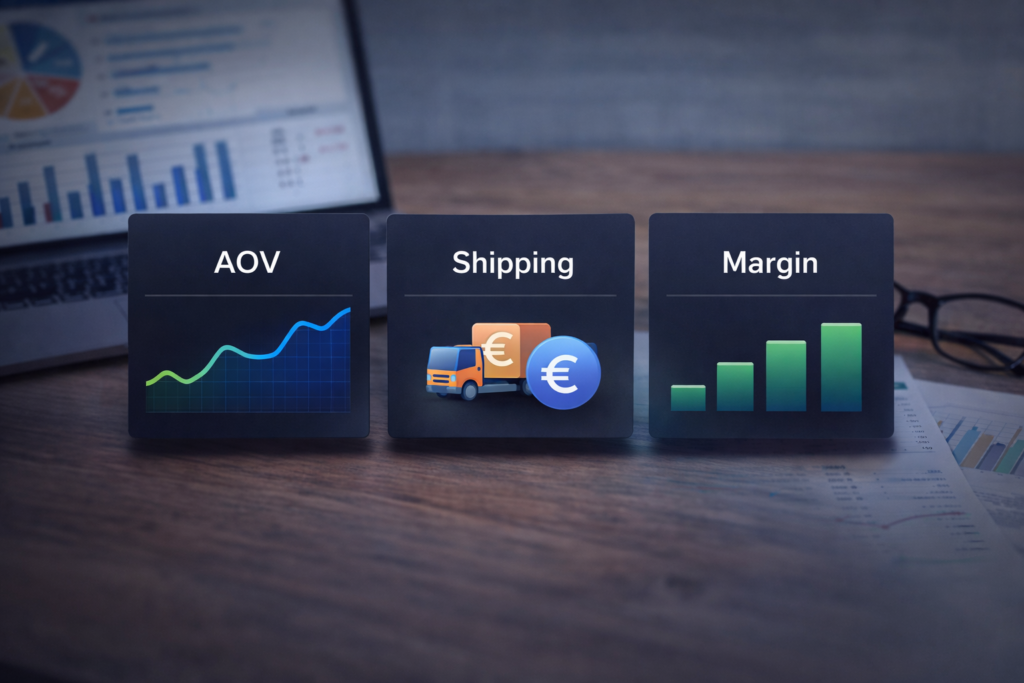
Before you set a free shipping threshold, you need a few key numbers.
Without them, you’re not optimizing — you’re guessing.
The three most important metrics are:
1. Average Order Value (AOV)
This tells you how much customers typically spend per order.
If your AOV is €50, your threshold should be slightly above that — not double, not random. This is your baseline.
If you’re not sure what a good AOV looks like for your store, it’s worth understanding industry benchmarks and how to interpret your numbers.
2. Average Shipping Cost
How much does shipping actually cost you per order?
If you’re offering free shipping, this is the cost you’ll be covering. Ignoring it means you could be losing money on every order that qualifies.
3. Profit Margin
This determines how much room you have to absorb shipping costs.
- High margins → more flexibility with lower thresholds
- Low margins → you need a higher threshold to stay profitable
Important: Your free shipping threshold must be profitable after shipping is covered — not just attractive to customers.
When you combine these three numbers, you get a clear picture:
- where your current baseline is (AOV)
- how much extra value you need (to cover shipping)
- how far you can push the threshold without hurting profit
Once you have this, setting the actual threshold becomes much easier — and much more accurate.
Simple Formula to Calculate Your Free Shipping Threshold
You don’t need complex calculations to set a good free shipping threshold.
A simple rule works surprisingly well:
Start with your Average Order Value and increase it by 20–30%
This creates a target that feels achievable but still pushes customers to spend more.
Basic Example
- Average Order Value: €50
- Suggested threshold: €60–€65
Most customers are already close, so adding one more product feels like a small step — not a big decision.
Adjusting Based on Your Margins
The 20–30% rule is a starting point, not a fixed rule.
You should adjust it based on your business:
- High margins → you can stay closer to +20%
- Lower margins → you may need +30% or more
If your average shipping cost is significant, make sure the extra amount covers it.
Quick Reality Check
Before finalizing your threshold, ask:
- Does this cover my shipping cost?
- Is it close enough to my current AOV?
- Would a customer realistically add one more item to reach it?
If the answer to any of these is “no”, adjust the number.
Important: The goal isn’t to set the highest possible threshold — it’s to set one that customers actually try to reach.
Real Examples (Low, Medium, High AOV Stores)
The exact number will vary from store to store, but the logic stays the same.
Here are a few realistic scenarios:
Low AOV Store (€20–€30)
- Average Order Value: €25
- Suggested threshold: €35
Customers are usually buying small, low-cost items. Asking them to jump to €50 would feel like too much.
But going from €25 to €35?
That’s often just one additional product.
Medium AOV Store (€50–€70)
- Average Order Value: €60
- Suggested threshold: €75
This is where free shipping thresholds tend to perform best.
Customers already expect to spend more, so increasing the cart by €10–€15 feels reasonable — especially if it unlocks free shipping.
High AOV Store (€100+)
- Average Order Value: €120
- Suggested threshold: €150
In higher-value stores, customers are less sensitive to small increases, but they still respond to clear incentives.
The key here is maintaining the same principle: the threshold should feel like a small step up, not a big leap.
What These Examples Have in Common
In all cases:
- The threshold is above AOV, but not dramatically higher
- The gap can usually be closed with one additional product
- The goal feels achievable during the purchase process
Important: Your threshold doesn’t need to be perfect on the first try — it just needs to be close enough to influence behavior.
How to Test and Optimize Your Threshold
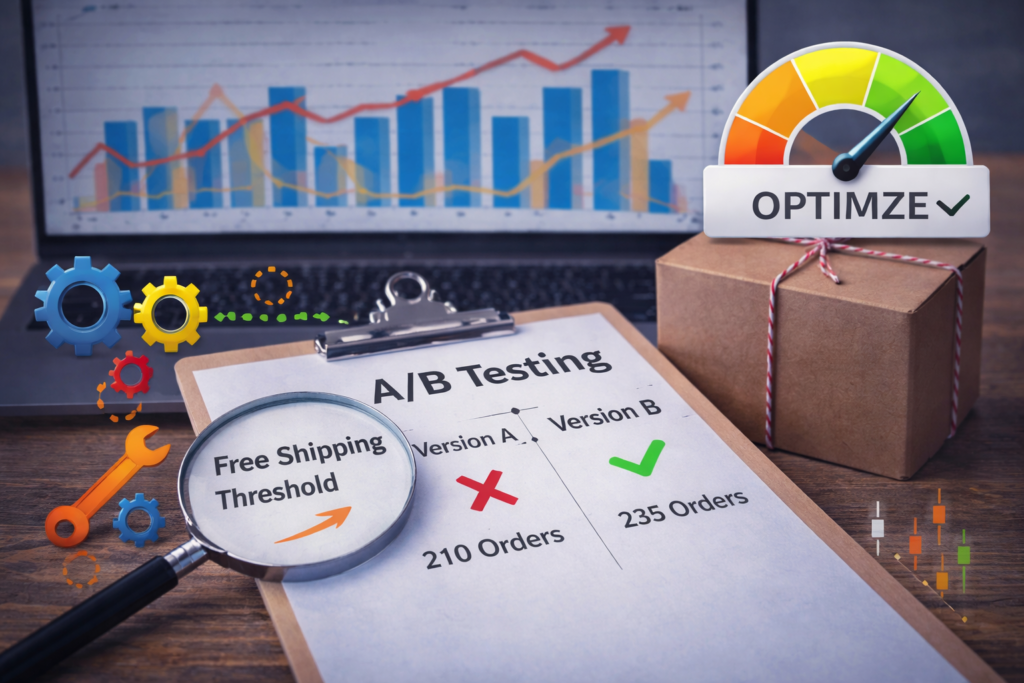
Setting your free shipping threshold is not a one-time decision.
What works for one store — or even one period — may not work long-term. The goal is to treat your threshold as something you test and improve over time.
Start With a Baseline
Use the formula from earlier (AOV + 20–30%) and run it for a few weeks.
This gives you a starting point based on data, not assumptions.
What to Track
Focus on a few key metrics:
- Average Order Value (AOV) → is it increasing?
- Conversion rate → are more or fewer people completing purchases?
- Profit per order → are you actually making more after shipping?
These three together tell you whether your threshold is working.
Simple Testing Approach
You don’t need complex tools to test this.
A practical approach:
- Set your initial threshold
- Run it for 2–3 weeks
- Increase or decrease it slightly (e.g. €5–€10)
- Compare results
Even small adjustments can have a noticeable impact.
Watch for Warning Signs
- AOV not increasing → threshold might be too low
- Conversion rate dropping → threshold might be too high
- Profit shrinking → shipping cost not properly covered
Each of these signals tells you how to adjust.
Keep in mind: A higher threshold is not always better. If customers stop trying to reach it, you lose the benefit entirely.
The goal is to find the balance where customers feel motivated — not pressured.
Implementation Tip: Make the Threshold Visible
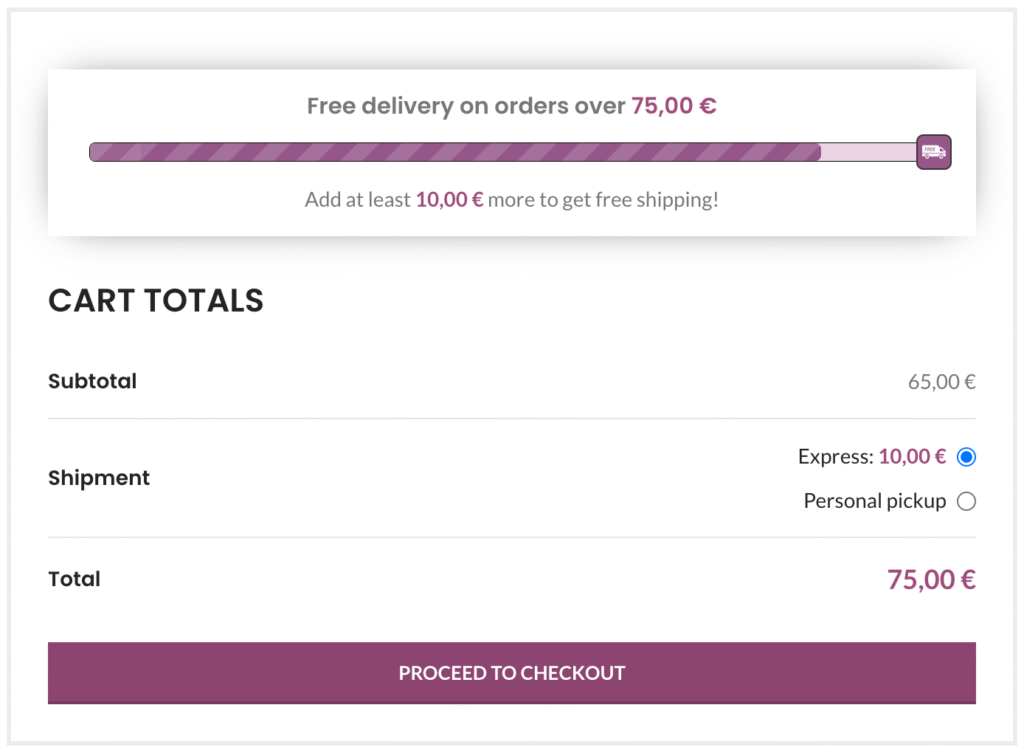
A free shipping threshold only works if customers can see it.
If the only place you mention it is in small text or on the shipping page, most shoppers will never notice it — and it won’t influence their behavior.
The key is visibility.
Customers should always know:
- how much they need to spend
- how close they are to free shipping
Why Visibility Matters
When the threshold is visible in the cart (or even earlier), it creates a clear goal:
“You’re only €8 away from free shipping.”
That small message often turns hesitation into action.
Without it, customers don’t calculate anything — they either continue or abandon the cart.
What Works Best
The most effective approach is a dynamic message or progress bar that updates in real time as the cart value changes.
This works especially well in:
- Cart page
- Mini-cart
- Checkout
It keeps the incentive in front of the customer at the exact moment they’re making a decision.
Practical Implementation
One practical way to implement this in WooCommerce is by showing a dynamic free shipping notice or progress bar that updates automatically based on the cart total.
Some stores handle this with custom code, while others use tools like a free shipping progress bar plugin to make the threshold visible without additional development.
Important: If customers don’t see the goal, they won’t try to reach it.
When Free Shipping Doesn’t Work (And What to Do Instead)
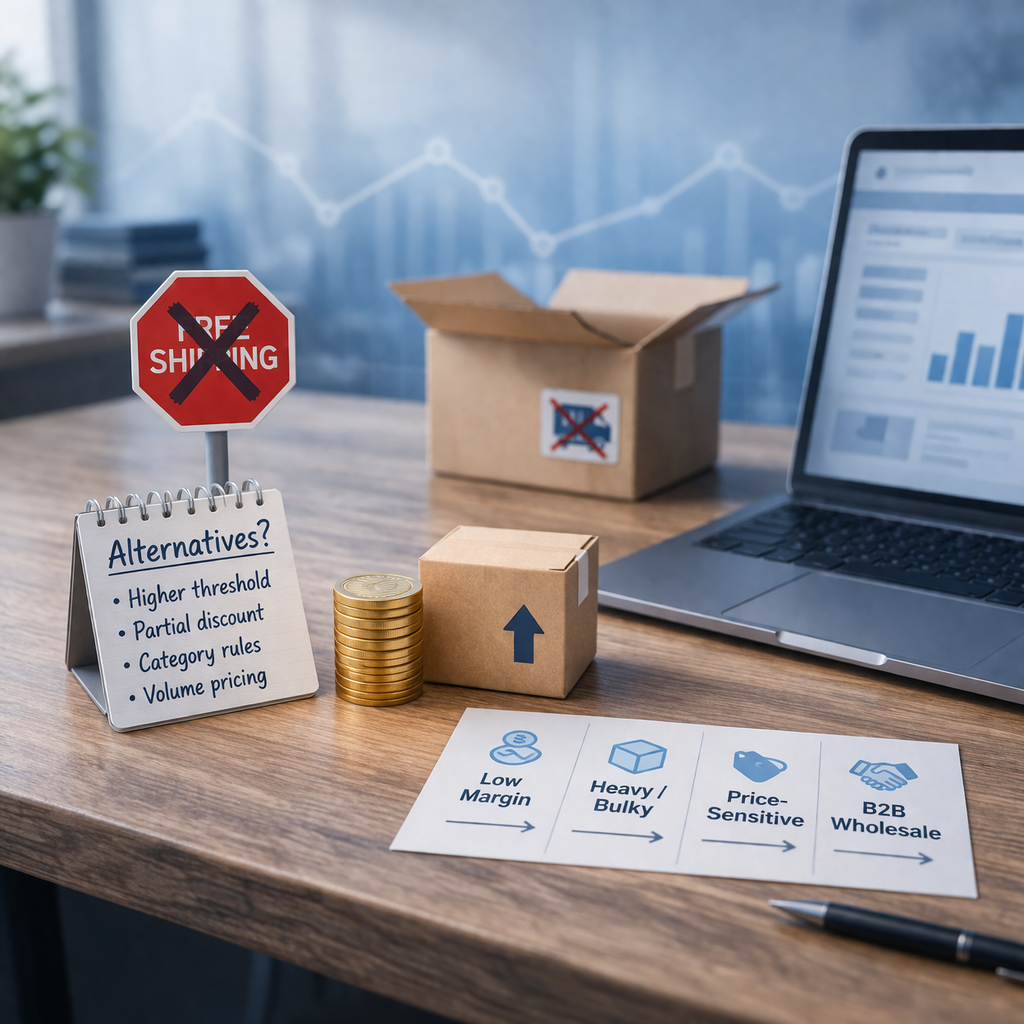
Free shipping is powerful, but it’s not always the right strategy.
In some cases, forcing a threshold can do more harm than good — especially if the numbers don’t support it.
Low Margin Products
If your margins are too tight, covering shipping costs can quickly eat into your profit.
In these cases, even a well-calculated threshold may not be enough.
Alternative:
Set a higher threshold or offer partial shipping discounts instead of full free shipping.
Heavy or Bulky Products
Shipping costs can vary significantly depending on product size and weight.
A single flat threshold may not work across your entire catalog.
Alternative:
Use category-based thresholds or exclude certain products from free shipping.
Price-Sensitive Customers
In some niches, customers are extremely price-focused.
If the gap to free shipping feels too large, they may abandon the cart instead of increasing it.
Alternative:
Test combining smaller incentives, such as:
- free shipping at a higher threshold
- small discounts at lower cart values
In many cases, combining these strategies can outperform using just one approach.
B2B or Wholesale Stores
In B2B environments, buyers are less influenced by psychological incentives and more focused on pricing, volume, and logistics.
Free shipping may not significantly impact behavior.
Alternative:
Focus on volume pricing, bulk discounts, or negotiated shipping terms.
Important: Free shipping should support your business model — not work against it.
If it doesn’t improve profitability or customer behavior, it’s better to adjust the strategy than force it.
Conclusion
A free shipping threshold isn’t just a number — it’s a strategy that directly influences how much customers spend.
When set correctly, it encourages shoppers to add more to their cart, increases average order value, and improves overall revenue without needing more traffic.
The key is to base your decision on data:
- start with your AOV
- account for shipping costs and margins
- set a threshold that feels achievable
From there, test and adjust.
Even small changes can have a meaningful impact over time.
Keep in mind: The goal isn’t to offer free shipping. The goal is to use it in a way that increases both order value and profitability.