Most customers don’t browse — they buy one thing and leave.
That’s the default behavior in most online stores. A customer lands on a product, adds it to the cart, and heads straight to checkout. No extras, no upgrades.
This is exactly why Average Order Value (AOV) matters.
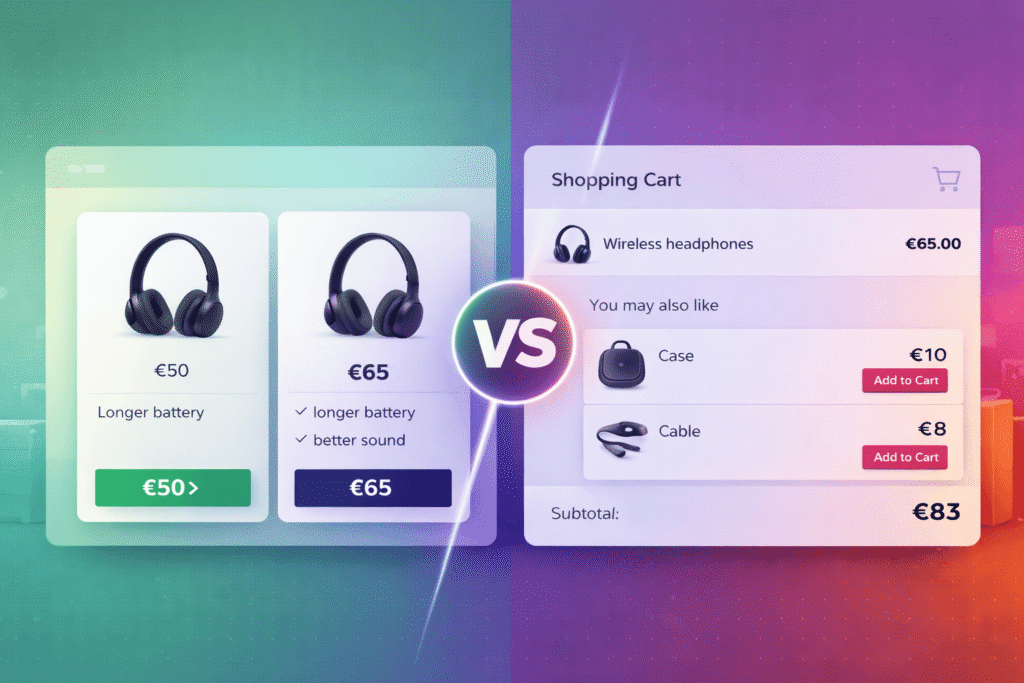
If your AOV increases from €50 to €65, that’s a 30% revenue boost — without more traffic, ads, or conversions. You’re simply getting more value from each order.
A big part of that comes down to upselling vs cross-selling — two strategies that can significantly increase how much each customer spends.
They’re often mentioned together, but they’re not the same strategy — and using them at the wrong moment can actually hurt conversions.
In this guide, we’ll break down the difference, show when each works best, and how to combine them to consistently increase your store’s AOV.
What Is Upselling?
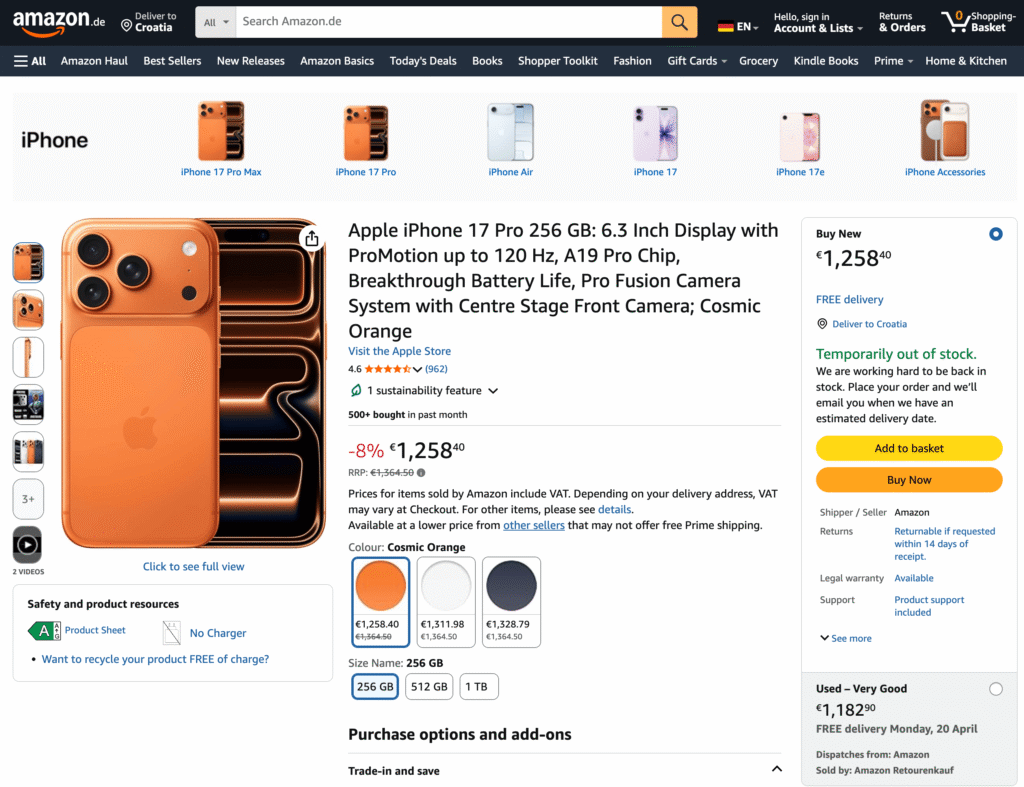
Upselling is the practice of encouraging customers to choose a more expensive or upgraded version of the product they’re already considering.
Instead of adding something new to the cart, the goal is to increase the value of a single item.
Simple examples:
- A customer looks at a €500 smartphone → you show the €550 version with better storage
- A basic subscription → you highlight the premium plan with extra features
- A standard product → you offer a “Pro” or “Bundle” version
The key idea is this: For a little more, you get significantly more value.
That’s why upselling works — it reframes the decision. The customer is already ready to buy, so you’re not asking for a new decision, just a slightly better one.
Keep in mind:
- Upsells work best when the price difference feels reasonable
- The upgrade must be clearly justified (better features, durability, savings)
- Too big of a jump kills conversions
Done right, upselling feels like a smart choice — not a pushy sales tactic.
What Is Cross-Selling?
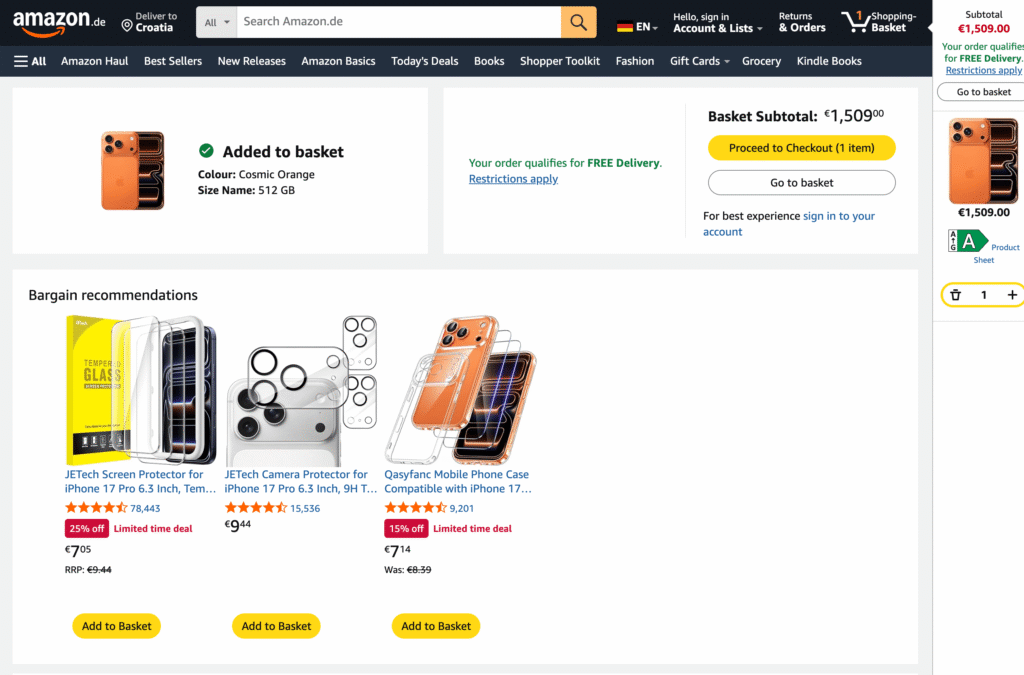
Cross-selling is the practice of suggesting additional, related products that complement what the customer is already buying.
Instead of upgrading the main product, you’re expanding the order.
Simple examples:
- Buying shoes → suggest socks or shoe care products
- Buying a laptop → suggest a mouse or a bag
- Buying a camera → suggest a memory card
The idea is straightforward: If you’re buying this, you’ll probably need this too.
That’s why cross-selling works — it removes friction. The customer doesn’t have to think about what else they might need. You’ve already done that for them.
Keep in mind:
- Cross-sells should be relevant, not random
- Lower-priced items tend to convert better
- Placement matters — cart and checkout are usually the strongest spots
Note: Keep checkout cross-sells minimal. At this stage, the customer is ready to pay — too many suggestions can slow them down or cause drop-off.
Done right, cross-selling feels helpful and convenient — like a complete solution, not an upsell disguised as noise.
Upselling vs Cross-Selling: Key Differences
Upselling and cross-selling often appear together, but they serve different purposes and work best at different moments.
Here’s the difference, stripped down:
| Upselling | Cross-selling | |
|---|---|---|
| Goal | increase the value of a single product | increase the total cart value |
| Focus | a better or more expensive version | additional, complementary products |
| Example | €500 phone → €550 upgraded model | laptop → add mouse (€20) |
| Best timing | product page, before adding to cart | cart or checkout |
The key distinction:
- Upselling changes the decision
- Cross-selling expands the decision
Both aim to increase order value, but they do it in completely different ways.
Understanding this difference is what allows you to use each strategy at the right moment — instead of throwing random offers and hoping something sticks.
When to Use Upselling (And When It Works Best)
Upselling works best before the customer commits to the purchase.
At that point, they’re still evaluating options — which makes it easier to guide them toward a better version.
The strongest moments for upselling:
- On the product page
Show a higher-tier option right next to the current product. The comparison should be obvious and easy to understand. - When the upgrade is clear
More storage, better materials, longer warranty, added features — the value difference must be immediately visible. - When the price jump feels reasonable
Going from €50 → €65 works.
Going from €50 → €120 usually doesn’t. - When the decision is simple
Too many upgrade options create friction. One strong upsell is better than five weak ones.
Example:
A customer is viewing a €40 pair of headphones.
You present a €55 version with:
- better sound quality
- longer battery life
- noise isolation
That extra €15 feels justified — and many customers will upgrade.
Important: if the upsell requires too much thinking or feels like a completely different product, it stops being an upsell — and starts hurting conversions.
Upselling should feel like a better version of the same decision, not a new decision entirely.
When to Use Cross-Selling (And Where It Converts Best)
Cross-selling works best after the main decision is already made.
At that point, the customer isn’t deciding what to buy anymore — just whether to add one or two extra items.
That’s why placement matters.
The strongest moments for cross-selling:
- In the cart
The customer sees their selection and is open to small additions that improve it. - At checkout
Works best for low-cost, impulse items (but keep it minimal). - After adding to cart (popups / side carts)
Great moment to suggest something relevant while intent is high.
Example:
Cart value: €62
You suggest:
- cleaning kit (€8)
- accessories (€10)
Instead of checking out immediately, the customer adds one item → new total €70+
Small additions, low friction, quick decision.
Why it works:
- The main purchase is already justified
- Additional items feel optional, not risky
- The cost increase is relatively small
Note: keep checkout cross-sells minimal. At this stage, the customer is ready to pay — too many suggestions can slow them down or cause drop-off.
Cross-selling is less about convincing — and more about making the order feel complete.
Combining Upselling and Cross-Selling for Maximum AOV
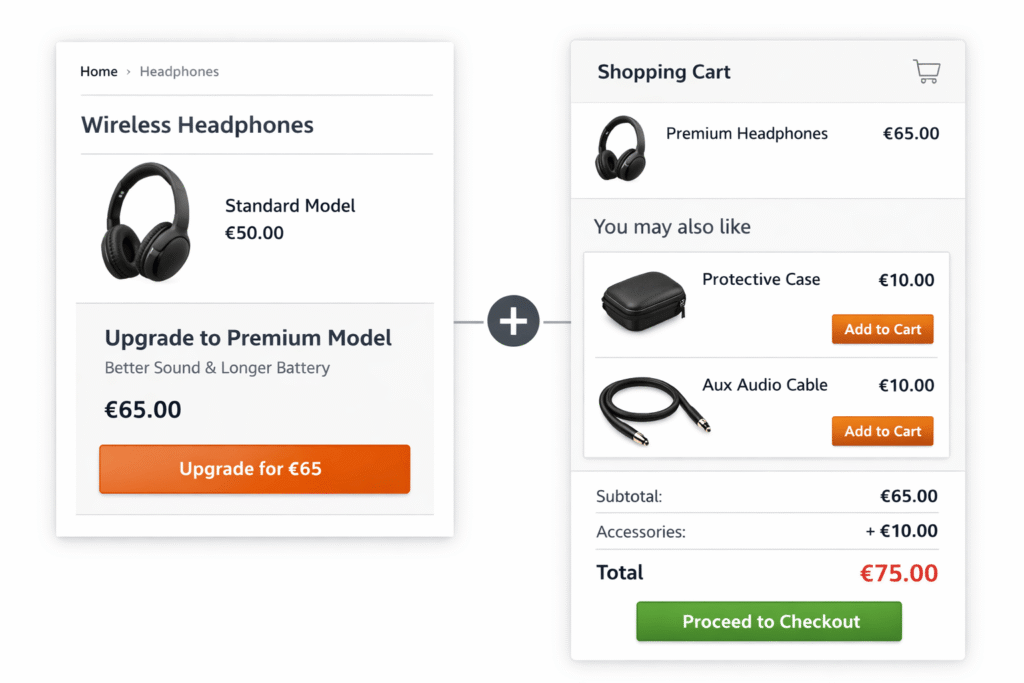
The real gains don’t come from choosing one strategy over the other — they come from using both at the right moments.
A simple flow looks like this:
- Product page → Upsell
Encourage a better version of the product - Cart → Cross-sell
Suggest complementary items to increase the total
Example:
A customer lands on a product priced at €50.
- On the product page, they upgrade to a €65 version (upsell)
- In the cart, they add a €10 accessory (cross-sell)
Final order value: €75
Instead of €50, you’ve increased revenue by 50% — without changing traffic or conversion rate.
This works because:
- Upselling increases the base value of the purchase
- Cross-selling increases the total value of the cart
They don’t compete — they stack.
Where many stores go wrong:
They try to do everything at once.
- Upsells in the cart
- Cross-sells on the product page
- Too many options everywhere
Result: confusion, friction, lower conversions.
The key is simple:
- Upsell before the decision
- Cross-sell after the decision
When structured properly, this creates a natural buying flow — not a sales funnel that feels forced.
Another effective approach similar to cross-selling is bundling products together. Instead of suggesting items separately, you present them as a single offer.
Common Mistakes to Avoid
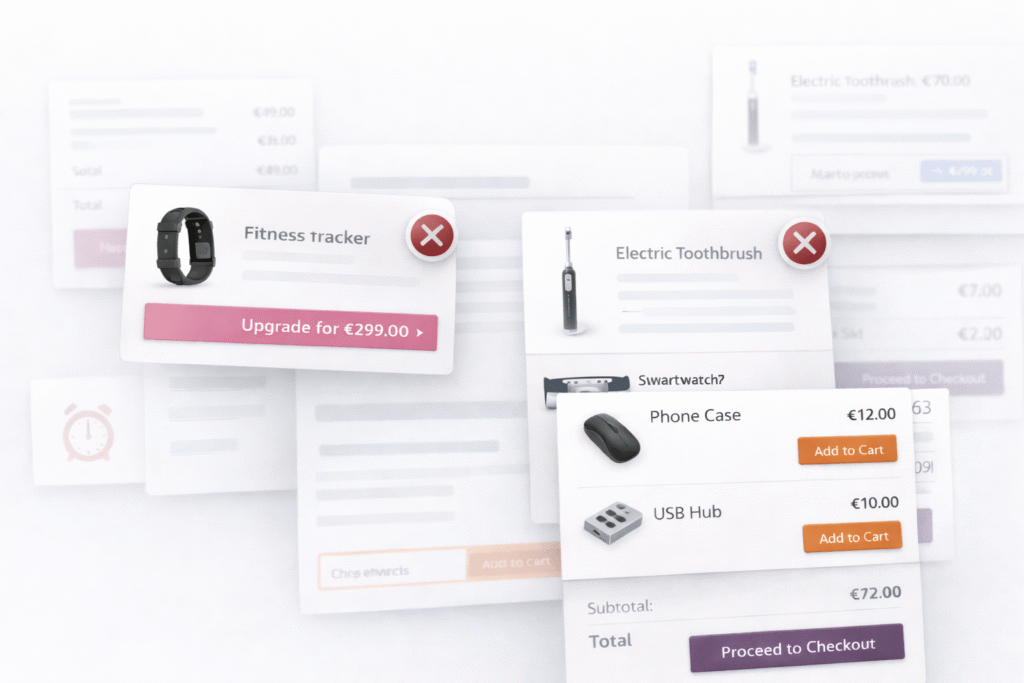
Even simple strategies like upselling and cross-selling can backfire if implemented poorly.
Here are the most common mistakes:
1. Too Many Offers
Showing multiple upsells and cross-sells at once creates decision fatigue.
Instead of increasing order value, you slow the customer down — or lose them completely.
Keep it simple: one strong upsell, a few relevant cross-sells.
2. Irrelevant Recommendations
Suggesting random products kills trust.
- Laptop → phone case ❌
- Laptop → mouse ✅
If the connection isn’t obvious, the offer feels forced.
3. Price Jumps That Don’t Make Sense
Upselling only works when the difference feels justified.
- €50 → €120 → risky ❌
- €50 → €65 → acceptable ✅
If the gap is too big, customers stick to the cheaper option — or abandon the purchase.
4. Wrong Timing
Showing the wrong offer at the wrong moment reduces conversions.
- Upsell in checkout → too late ❌
- Cross-sell before product decision → distracting ❌
Timing matters as much as the offer itself.
5. Ignoring User Intent
Not every customer wants more.
If someone is clearly trying to check out quickly, aggressive offers can feel like friction.
Important: these strategies should feel like helpful suggestions, not interruptions.
If your offers slow down the buying process instead of supporting it, they’re doing more harm than good.
Implementation Tip
Understanding the strategy is one thing — implementing it correctly is where most stores struggle.
A simple way to apply both upselling and cross-selling is to align them with the buying flow:
- Product page → highlight a better version (upsell)
- Cart → suggest complementary items (cross-sell)
One additional layer that works extremely well here is free shipping incentives.
For example:
Cart value: €62
Free shipping threshold: €75
At this point, cross-selling becomes much easier.
Instead of convincing the customer to “spend more,” you’re giving them a clear reason: add one more item and avoid paying for shipping.
This turns cross-selling into a goal-driven action, not just a suggestion.
One practical way to support this is by showing customers how close they are to unlocking free shipping.
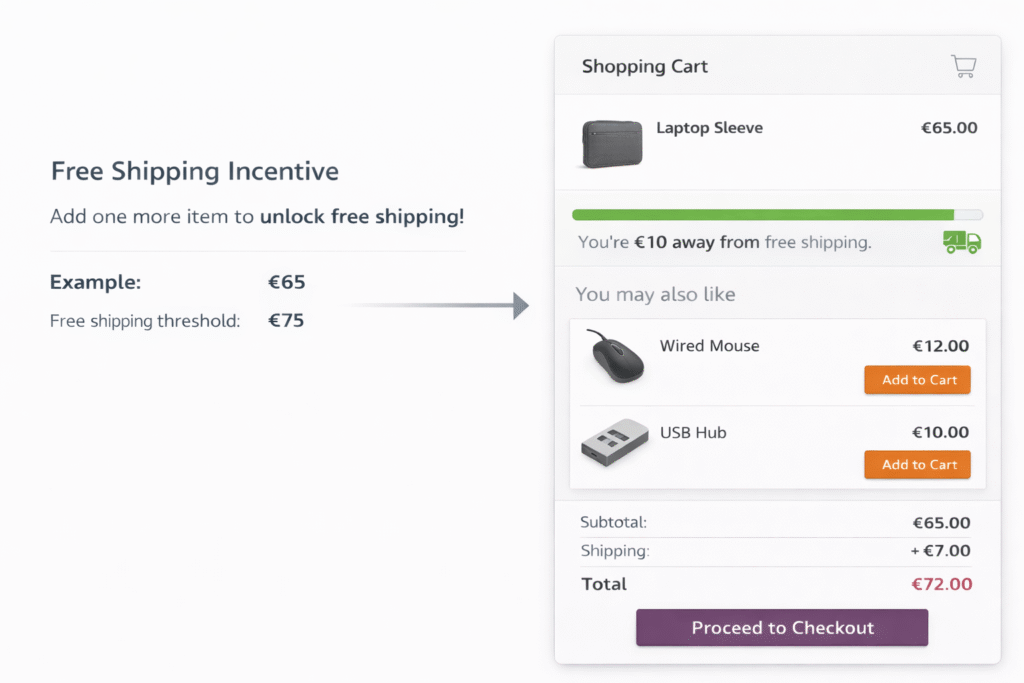
A simple progress indicator or message can make the goal visible and encourage small additions to the cart. Some stores implement this using tools like a free shipping progress bar that updates in real time as the cart value changes.
Setting the right free shipping threshold is critical. If you’re not sure where to start, this guide explains how to calculate it based on your margins and order value.
The key idea is simple: don’t just show offers — give customers a reason to act on them.
Conclusion
Upselling and cross-selling are often treated as the same thing, but they solve different problems.
Upselling increases the value of a single decision.
Cross-selling increases the value of the entire order.
Used correctly, they work together.
Upsell early, when the customer is still choosing.
Cross-sell later, when the main decision is already made.
Small changes here can have a big impact.
If your average order value increases even slightly, the effect compounds across every sale — without needing more traffic or higher conversion rates.
That’s why these strategies matter.
Not because they’re complex, but because they’re simple — and they work.