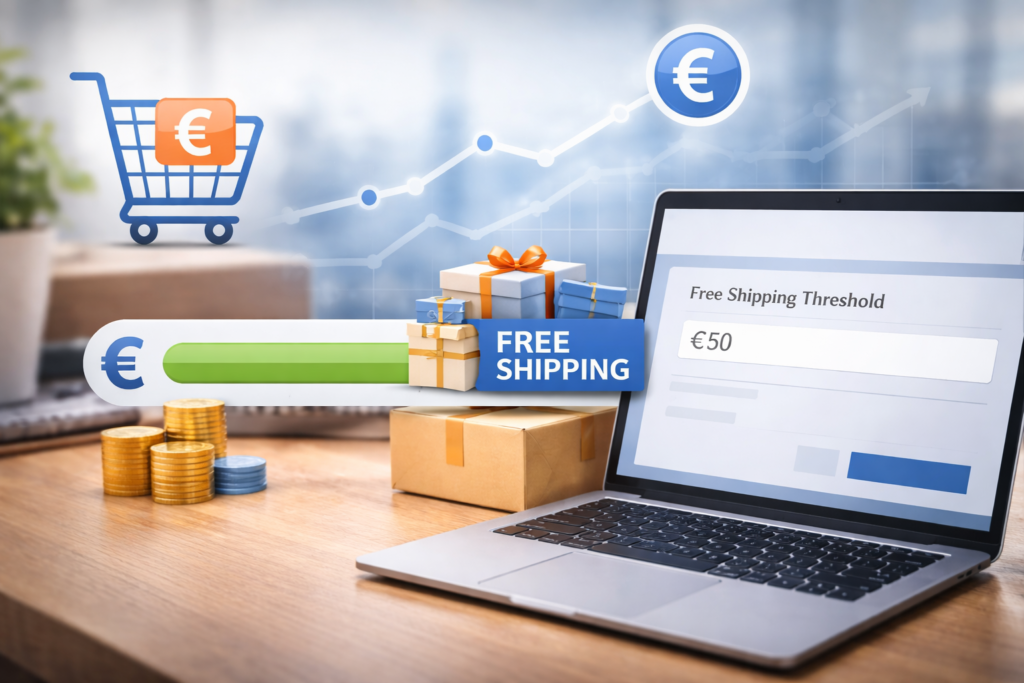
If you want to increase average order value in WooCommerce, you don’t need more traffic — you need better cart strategy.
Traffic matters, but it’s expensive and increasingly competitive. There is another lever that often produces faster results with far less risk: Average Order Value (AOV).
AOV measures how much a customer spends per order. The formula is simple:
AOV = Total Revenue ÷ Number of Orders
In this guide, you’ll learn how to increase average order value in WooCommerce using practical, margin-safe strategies.
If your store generates €10,000 from 200 orders, your AOV is €50. If you increase that to €60 while keeping the same number of orders, revenue rises to €12,000. That’s a 20% revenue increase without acquiring a single new customer — no additional ad spend, no new traffic sources, no complex funnels. Just better cart strategy.
The important part is this: increasing AOV should not feel manipulative. When implemented correctly, it improves the customer experience while increasing revenue in a sustainable way.
Before we look at practical strategies, it is important to clarify what AOV actually represents — and what it does not.
What AOV Is Not
AOV is frequently misunderstood. Optimizing it incorrectly can inflate revenue while quietly hurting margins or conversions.
AOV is not profit
A higher order value does not automatically mean higher profitability. Poorly calculated discounts or free shipping incentives can increase revenue while shrinking contribution margin.
Every AOV strategy must be evaluated against product margins, shipping costs, payment fees, and discount structure. Otherwise, you are scaling volume instead of profit.
AOV is not conversion rate
Conversion rate measures how many visitors buy. AOV measures how much each buyer spends.
They are related but not interchangeable. Some AOV strategies, such as raising a free shipping threshold, may slightly reduce conversion rate while increasing overall revenue and profit. That trade-off can be entirely rational if margins improve.
AOV is not “just raise prices”
Simply increasing prices is not AOV optimization. If pricing exceeds perceived value, conversion drops and total revenue may decline.
Real AOV optimization focuses on cart mechanics: thresholds, bundles, upsells, add-ons, volume pricing, and shipping logic. It is about influencing cart composition, not forcing higher price tags.
AOV is not a rescue tool
If your store struggles with poor traffic quality, weak product-market fit, checkout friction, or high refund rates, AOV optimization will not solve those foundational issues.
It is a growth accelerator, not a shortcut.
Why Increasing Average Order Value Is More Profitable Than Traffic
Most WooCommerce stores try to grow by increasing traffic. On the surface, that makes sense. More visitors should mean more sales.
But traffic growth comes with predictable costs:
- paid acquisition expenses
- rising CPCs
- creative testing
- attribution complexity
- higher operational load
If your average order value is low, every new visitor must convert at a higher rate just to cover acquisition costs. That creates pressure on your entire funnel.
When a customer is already in buying mode, the cost of increasing their cart value is dramatically lower than the cost of acquiring a new customer. You are optimizing existing purchase intent rather than trying to create it.
Assume:
- Average Order Value = €50
- Gross margin = 40%
- Customer acquisition cost (CAC) = €20
Your gross profit per order is €20. After acquisition cost, you break even.
Now increase AOV to €65 without increasing acquisition cost. With the same 40% margin, gross profit becomes €26. Your net profit per order jumps from €0 to €6.
You didn’t improve traffic or conversion rate — you improved cart value.
That difference compounds quickly at scale.
This is why serious eCommerce operators treat AOV as a core metric, not a side optimization.
The next question is not whether you should optimize AOV — it’s how to do it without damaging conversion or customer trust.
Let’s break down the most effective strategies, starting with the one that usually has the strongest psychological impact: threshold-based incentives.
Strategy #1: Threshold-Based Free Shipping
If there is one AOV strategy that consistently works across industries, it is threshold-based incentives — especially free shipping.
Customers hate paying for shipping more than they dislike slightly increasing their cart total. A €4.90 shipping fee often feels more painful than adding a €12 product to qualify for free delivery.
Why It Works
Free shipping introduces a clear, measurable goal. Instead of asking customers to “buy more,” you give them a target:
“Spend €60 and unlock free shipping.”
That shift turns the cart into a goal: “What can I add to reach the threshold?”
When implemented correctly, this strategy:
- increases average cart size
- reduces cart abandonment
- improves perceived value
- feels like a reward, not pressure
However, free shipping is not automatically profitable. It must be calculated carefully.
The Margin Check (Before You Do Anything)
Before setting a threshold, calculate:
- average current AOV
- average shipping cost
- product margin
- fulfillment cost
If your current AOV is €47 and you set free shipping at €50, you will not meaningfully move behavior. If you set it at €120 when your AOV is €45, most customers will ignore it.
A practical starting rule is: set the threshold 20–30% above your current AOV.
If AOV is €50, test €60–€65.
That gap should feel reachable but not automatic.
Visibility Is What Makes It Work
A hidden threshold does nothing.
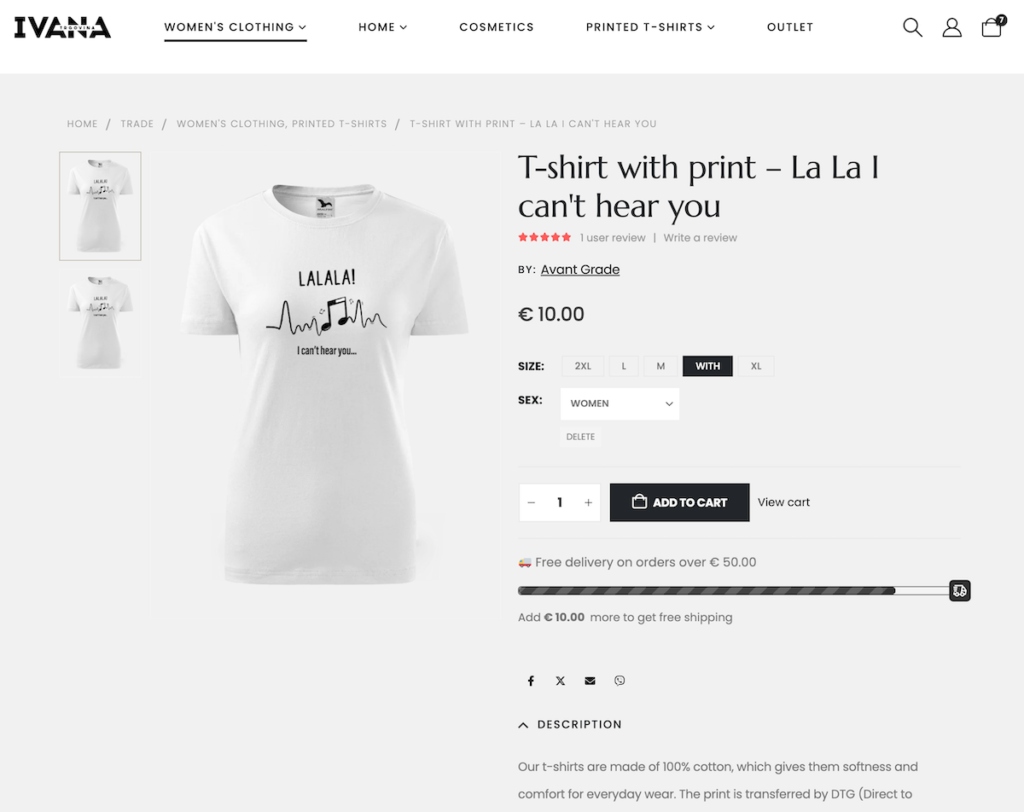
If customers only see “Free shipping on orders over €60” buried in a footer, behavior will barely change. The incentive must be visible during the shopping process.
This is where progress-based communication becomes important.
Instead of a static message, show customers exactly how close they are to the goal.
For example:
“You’re €12 away from free shipping.”
That micro-feedback is what drives action.
A dynamic progress bar makes the incentive tangible. It reduces cognitive effort and creates a sense of completion bias — people like finishing what they start.
This is precisely the logic behind the Free Shipping Label plugin. It keeps the free shipping goal visible in the cart and checkout, shows customers how close they are to qualifying, and updates dynamically as items are added.
Used correctly, it turns a pricing condition into a motivation tool.
Pros of Free Shipping Thresholds
- Strong psychological pull
- Works across most industries
- Easy to test and measure
- Can reduce cart abandonment
- Feels customer-friendly
Cons of Free Shipping Thresholds
- Can damage margins if poorly calculated
- May reduce profit on heavy or low-margin items
- Slightly higher threshold can reduce conversion rate
- Requires proper visibility to be effective
Free shipping is powerful — but only when structured around margin and communicated clearly.
In many cases, combining it with additional steps (such as discounts or rewards at higher thresholds) creates even stronger results. We’ll come back to that.
Strategy #2: Structured Upsells and Smart Add-Ons
If free shipping uses a threshold goal, upsells use relevance.
The idea is simple: once a customer commits to buying, their resistance to related purchases drops significantly. The key word is related. Random product suggestions rarely increase AOV. Contextual ones do.
A structured upsell strategy focuses on improving the original purchase, not distracting from it.
There are three primary forms that work well in WooCommerce.
1. Complementary Add-Ons
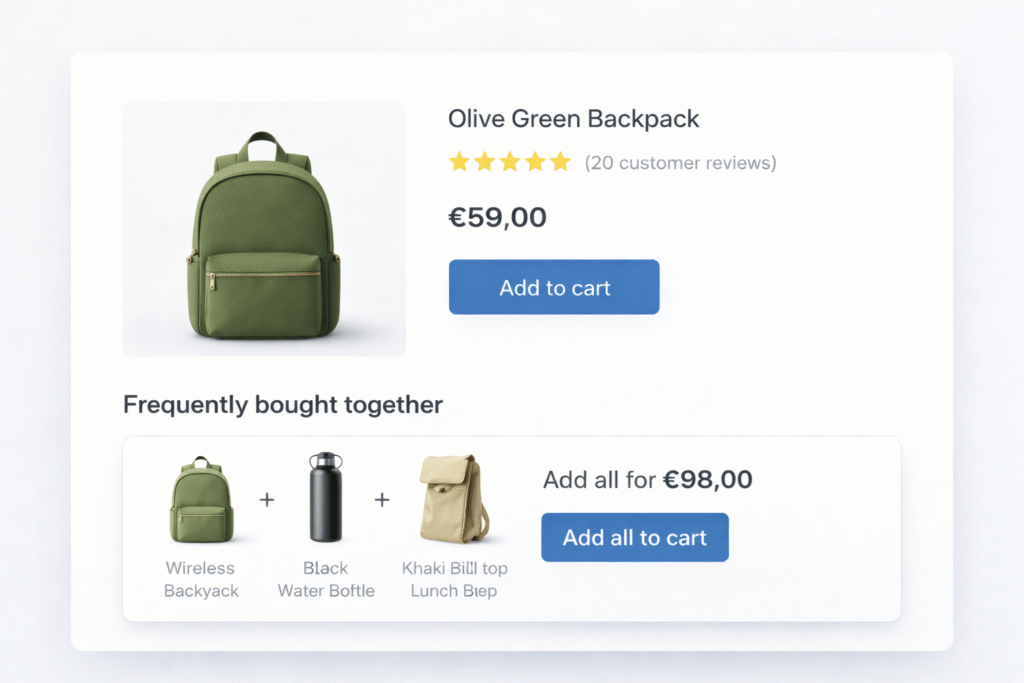
These are logical extensions of the product already in the cart.
Examples:
- Extra batteries for electronics
- Care products for shoes
- Extended warranty for higher-ticket items
- Matching accessories
The rule is clarity. The add-on must make sense instantly. If the customer has to think too much about why they need it, conversion drops.
From a margin perspective, small accessories often carry higher profit percentages than main products. That makes them powerful AOV drivers.
2. Premium Upgrades
Instead of adding another product, you encourage customers to upgrade the one they’re buying.
Examples:
- Standard → Premium version
- Basic material → Higher quality finish
- 30-day plan → 90-day bundle
This strategy increases AOV without increasing SKU complexity in the cart. It simply shifts the price tier upward.
The important part is anchoring. Customers must clearly understand what additional value they receive. Otherwise, it feels like upselling for the sake of upselling.
3. Cart-Level Upsells
These appear after a product is added to the cart.
Examples:
- “Frequently bought together”
- Bundle suggestions
- Limited-time cross-sell offers
Cart-level upsells work best when they feel helpful rather than aggressive. One strong, relevant suggestion performs better than five random ones.
Why Upsells Work
Once a customer decides to purchase, resistance drops. If your store supports that momentum with relevant suggestions, AOV increases without harming conversion rate.
Pros of Structured Upsells
- High margin potential
- Does not rely on shipping incentives
- Works well for mid- to high-priced products
- Improves perceived value when relevant
Cons of Poorly Executed Upsells
- Too many suggestions reduce clarity
- Irrelevant products hurt trust
- Aggressive popups damage experience
The principle is simple: improve the purchase, don’t complicate it.
Next, we’ll look at a strategy that works especially well for consumables and repeat purchases: volume incentives and multi-step rewards.
Strategy #3: Volume Incentives and Multi-Step Rewards
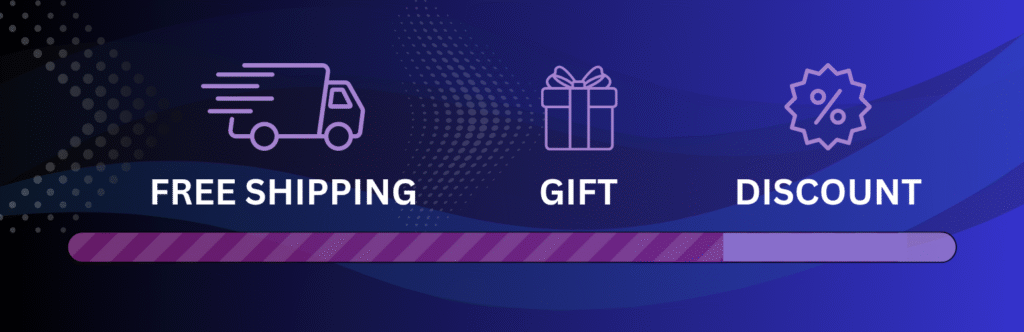
Free shipping gives customers one goal. Volume incentives give them multiple.
Instead of a single threshold, you introduce progressive rewards. The higher the cart value, the better the benefit.
For example:
- Spend €60 → Free shipping
- Spend €80 → 5% discount
- Spend €100 → 10% discount
This structure works because it introduces progression. Once customers are close to the first reward, they naturally evaluate whether the second one is within reach.
It transforms the cart into a ladder rather than a finish line.
Why Multi-Step Rewards Increase AOV
Visible progress drives action. When shoppers see they are “almost there,” they complete the objective.
A single free shipping goal may lift AOV moderately. Adding structured steps can amplify the effect because:
- It keeps momentum after the first reward is unlocked
- It increases perceived value
- It encourages slightly larger cart additions
This works particularly well in:
- Consumable products
- Apparel
- Beauty
- Supplement stores
- Gift-heavy catalogs
The key is balance. Each step must be achievable but not automatic.
Margin Discipline Still Applies
Multi-step rewards are powerful — but dangerous if poorly calculated.
Before launching, calculate:
- Blended product margin
- Average shipping cost
- Expected discount impact
- Payment processing fees
If your margin cannot support stacked incentives, simplify the structure.
The goal is sustainable AOV growth, not inflated revenue with shrinking profit.
Visualizing Progress Matters

Like with free shipping, structure alone is not enough. Customers must see their progress in real time.
A dynamic progress bar showing multiple goals makes the system intuitive. Instead of explaining discounts in text, you let customers visually track their status.
The Free Shipping Label plugin supports this logic through additional discount steps, allowing you to create single, double, or triple goal structures. When customers see multiple milestones ahead, they are more likely to stretch their cart value to unlock the next reward.
Used responsibly, this approach increases AOV without increasing pressure.
Pros of Volume and Multi-Step Incentives
- Strong psychological momentum
- Encourages larger incremental increases
- Works especially well for repeat buyers
- Can improve customer loyalty
Cons
- Requires careful margin modeling
- Too many steps can confuse customers
- Overly aggressive discounts reduce profitability
When structured correctly, this strategy often outperforms simple free shipping alone.
Next, we’ll move into a different category of AOV optimization — one that doesn’t rely on discounts at all: price anchoring and bundle positioning.
Strategy #4: Bundles and Price Anchoring
Not all AOV growth needs discounts.
In many cases, you can increase cart value simply by changing how products are presented and structured.
Bundles and price anchoring work by reframing value rather than reducing price.
Product Bundles

Bundles combine related products into a single offer, usually at a slight perceived advantage.
For example:
- Skincare routine set instead of individual items
- “Starter kit” instead of separate components
- 3-pack instead of single unit
Bundles increase AOV because they:
- simplify decision-making
- reduce comparison fatigue
- create perceived savings
- increase item count naturally
The important detail is clarity. Customers must clearly see the benefit of buying the bundle versus purchasing items separately.
A bundle does not need to offer a massive discount. Even a small visible advantage can be enough when convenience is part of the value.
Price Anchoring
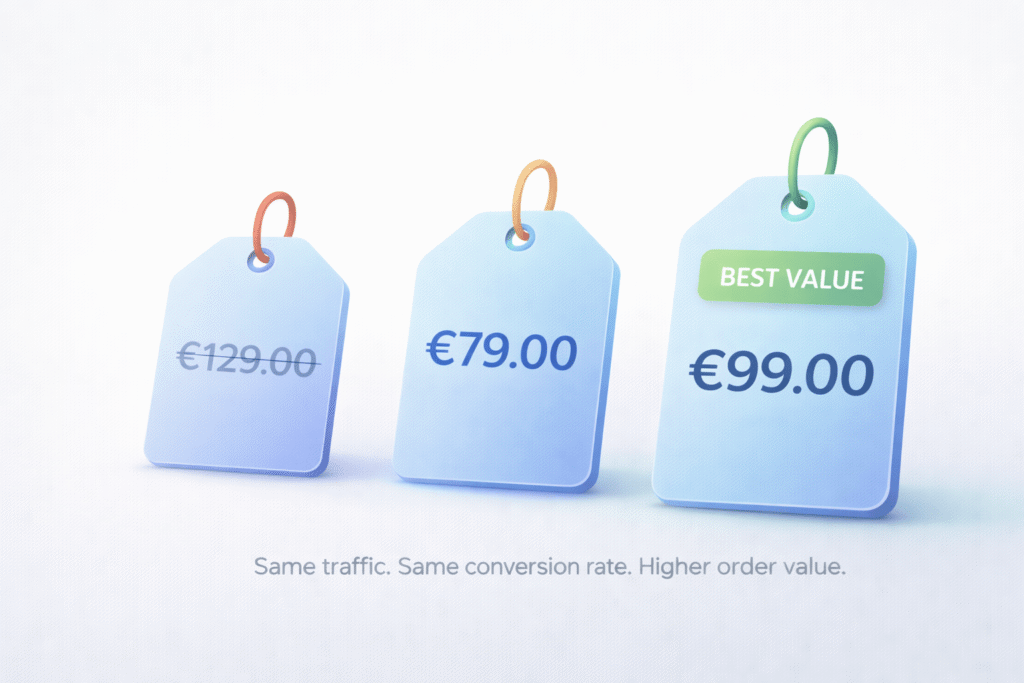
Price anchoring works by placing higher-priced options next to standard ones.
For example:
- Basic – €29
- Standard – €49
- Premium – €79
Even if most customers choose the middle option, the presence of the higher tier shifts perception. The €49 option feels reasonable compared to €79.
This is particularly effective for:
- Subscription plans
- Service add-ons
- Product variations
- Digital goods
Anchoring increases AOV without adding friction because customers feel they are making a better choice — not being pushed into spending more.
Why This Works
Customers evaluate price comparatively. When pricing is structured intentionally, mid-tier and premium options become more attractive without adding friction.
Pros of Bundles and Anchoring
- No dependency on shipping incentives
- Higher perceived value
- Strong for medium and high-ticket stores
- Protects margins better than heavy discounting
Cons
- Requires thoughtful product structure
- Weak value communication reduces effectiveness
- Poorly designed bundles increase confusion
Bundles and anchoring work best when the offer feels curated rather than artificially constructed.
Next, we’ll move into a strategy many store owners underestimate: post-purchase and repeat-driven AOV expansion.
How to Choose the Right AOV Strategy for Your Store
Not every strategy fits every WooCommerce store. The right starting point depends on your margins, product structure, and customer behavior.
If you sell low- to mid-priced physical products with stable margins, threshold-based incentives are often the fastest win. A properly calculated free shipping threshold, clearly communicated in the cart, can produce immediate AOV lift.
If your catalog supports logical add-ons or premium variations, structured upsells and bundles may outperform shipping incentives. These approaches protect margins better and feel less promotional, particularly for higher-ticket products.
If you sell consumables or products with repeat buying behavior, multi-step rewards and volume logic can drive larger incremental increases by encouraging customers to stretch their cart value.
Across all strategies, one principle remains constant: margin discipline.
Before launching any AOV experiment, calculate:
- current average order value
- gross margin
- average shipping cost
- payment processing fees
- expected discount impact
AOV optimization only works when profit scales with revenue.
For many WooCommerce stores, a well-structured free shipping threshold with visible progress tracking is the simplest starting point. When customers can clearly see how close they are to unlocking a benefit, behavior changes naturally. Tools like the Free Shipping Label plugin make that communication visible across cart and checkout, turning a pricing rule into a motivational mechanism.
Increasing traffic is expensive. Increasing cart value is often more efficient.
Sustainable growth rarely comes from chasing more visitors. It comes from structuring the cart more intelligently.