
Average Order Value (AOV) is one of the most important metrics in eCommerce, yet many store owners are unsure how to interpret it.
You can increase traffic, improve conversion rates, and launch new marketing campaigns — but if the average value of each order stays low, overall revenue growth becomes much harder.
Average Order Value measures how much customers spend per transaction. When this number increases, revenue grows without needing more visitors or more orders.
Important: Improving AOV is often one of the most efficient ways to increase revenue. When customers are already in buying mode, encouraging them to add one more item to the cart is usually easier than acquiring a new customer.
In this guide, we’ll explain what a good Average Order Value looks like for eCommerce stores, how to calculate it correctly, and what factors influence whether your AOV is healthy or needs improvement.
What Is Average Order Value (AOV)?
Average Order Value (AOV) measures the average amount of money a customer spends each time they place an order in your store.
Instead of focusing on how many orders you receive, AOV focuses on how much revenue each order generates. This makes it a useful metric for understanding purchasing behavior and evaluating the effectiveness of your pricing and marketing strategies.
For example, if your store generates €10,000 in revenue from 200 orders, the average value of each order is €50. That number represents your Average Order Value.
Note: AOV does not measure profitability directly. A store with a high AOV can still be unprofitable if margins are low, shipping costs are high, or acquisition costs are too expensive.
Because of this, AOV should always be analyzed together with metrics such as gross margin, conversion rate, and customer acquisition cost.
Understanding AOV helps store owners answer practical questions:
- Are customers buying only one product per order?
- Are pricing and bundling strategies effective?
- Are incentives like free shipping thresholds encouraging larger carts?
Once you understand what AOV represents, the next step is learning how to calculate it correctly.
How to Calculate Average Order Value

Calculating Average Order Value is straightforward. The metric simply divides total revenue by the number of orders during a specific period.
Formula:
Average Order Value = Total Revenue ÷ Number of Orders
For example, imagine your store generated €12,000 in revenue from 240 orders during one month.
Your calculation would look like this:
€12,000 ÷ 240 = €50 AOV
This means that, on average, each customer order is worth €50.
Most eCommerce platforms calculate this automatically. In WooCommerce, you can estimate AOV by comparing total sales and total orders for a selected time period. Analytics tools such as Google Analytics, Shopify Analytics, or dedicated reporting plugins also display this metric.
Keep in mind: AOV should always be analyzed within a specific timeframe — such as a month, quarter, or campaign period. Looking at AOV over time helps you understand whether changes in pricing, promotions, or marketing campaigns are influencing how much customers spend per order.
Once you know how to calculate AOV, the next logical question is: what actually counts as a good Average Order Value?
So, What Is a Good Average Order Value (AOV)?
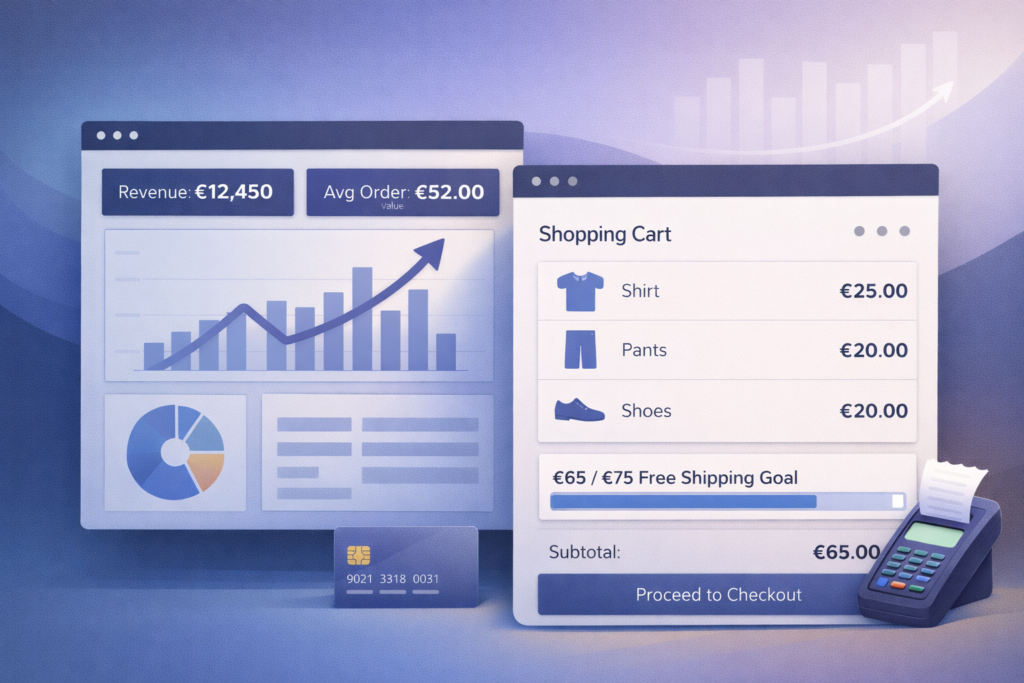
There is no single number that defines a “good” Average Order Value. What counts as healthy for one store may be unrealistic for another.
AOV depends heavily on several factors, including the type of products you sell, their price range, and your overall business model.
For example:
- A fashion store selling €25 T-shirts may have an AOV around €50–€70 if customers typically buy two or three items.
- A beauty store selling €12 cosmetics might see an AOV closer to €30–€40.
- A furniture store, where products are much more expensive, could easily have an AOV of €300 or more.
Important: AOV should always be evaluated relative to your product prices and margins, not compared blindly with other industries.
Another useful way to evaluate AOV is to compare it with your customer acquisition cost (CAC). If your marketing campaigns cost €20 to acquire a customer and your average order value is €25, your margins will be extremely tight. On the other hand, if your AOV is €80 with the same acquisition cost, the economics of your store are far healthier.
Keep in mind: A “good” AOV is one that allows your store to cover acquisition costs, shipping, and operational expenses while still leaving a sustainable profit margin.
Average Order Value benchmarks vary significantly across industries, it’s often more useful to look at industry benchmarks rather than searching for a universal number.
Average Order Value Benchmarks by Industry
Because product prices vary significantly across industries, Average Order Value can differ widely between stores. A fashion store, for example, will naturally have a much lower AOV than a furniture retailer.
Industry benchmarks can provide a rough point of reference. According to data published by Shopify, the average order value for many eCommerce stores typically falls somewhere between $50 and $100, although this range varies widely depending on the product category.
For context, typical ranges may look like this:
| Fashion and apparel | €50–€80 |
| Beauty and cosmetics | €30–€60 |
| Electronics | €100–€300 |
| Home and furniture | €200–€600 |
| Luxury products | €500+ |
These numbers should be treated as general benchmarks, not strict targets. Two stores in the same industry can still have very different AOV depending on their pricing strategy and product mix.
Note: Benchmarks are most useful when comparing your store against similar businesses with similar product pricing. Comparing a store that sells €15 accessories with one selling €200 designer products will not produce meaningful insights.
For this reason, many successful eCommerce stores focus less on hitting a specific benchmark and more on gradually increasing their own AOV over time. Even small improvements can have a significant impact on revenue.
What Determines Your Average Order Value

Average Order Value is not random. It is shaped by several structural factors within your store and product catalog.
Understanding these factors helps explain why some stores naturally have higher AOV than others.
Product Price Range
The price of your products is the strongest driver of AOV. Stores selling €15 accessories will almost always have a lower AOV than stores selling €300 furniture.
However, the key factor is not the price of a single product, but the typical combination of products customers purchase together.
For example, a clothing store may sell €30 shirts but still achieve a €90 AOV if customers commonly buy three items per order.
Product Catalog Structure
Stores with complementary products tend to generate larger carts.
When customers can easily add related items — such as accessories, refills, or matching products — the likelihood of multi-item orders increases.
In contrast, stores that sell mostly standalone products often see lower AOV because customers typically purchase only one item.
Target Customer Behavior
Different audiences shop differently.
Some customers prefer frequent small purchases, while others place larger but less frequent orders.
For example:
- grocery and consumable products often lead to larger baskets
- specialty or luxury items are usually purchased individually
This naturally affects average order size.
Purchase Intent
AOV also depends on the context in which customers arrive at your store.
Customers who come from product-specific searches often purchase a single item. On the other hand, customers browsing categories or responding to promotions are more likely to add multiple products to their cart.
Keep in mind: AOV is not only a pricing metric. It reflects how customers interact with your catalog, how products relate to each other, and how purchasing decisions are made.
Once these underlying factors are understood, it becomes easier to identify which strategies can realistically increase your Average Order Value.
Practical Ways to Increase Average Order Value
Once you understand what determines your Average Order Value, the next step is identifying practical ways to increase it.
Even small improvements can have a meaningful impact on revenue. For example, increasing AOV from €50 to €60 increases revenue by 20% without requiring additional traffic.
Below are several strategies commonly used by eCommerce stores.
Set a Free Shipping Threshold
Free shipping is one of the strongest purchase incentives in eCommerce.
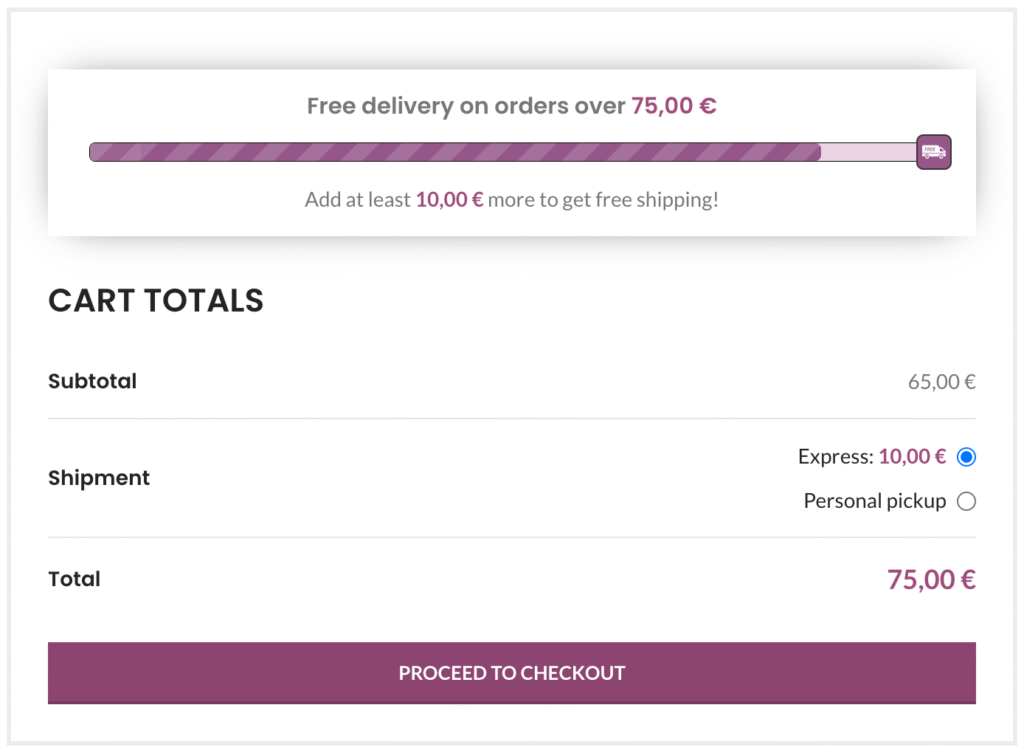
Many stores set a minimum order value for free shipping slightly above their current AOV. When customers see that they are close to reaching the threshold, they often add another item to avoid paying for delivery.
For example, if your current AOV is €48, setting free shipping at €60 encourages customers to increase their cart value.
Note: The threshold should be high enough to increase order value but still realistic for customers to reach.
Some WooCommerce stores make this incentive more visible by showing customers how close they are to unlocking free shipping. A dynamic message or progress bar can update automatically as items are added to the cart.
Tools such as Free Shipping Label for WooCommerce allow stores to display this type of progress indicator in the cart or mini-cart, making the free shipping goal clear during the shopping process.
Offer Product Bundles
Product bundles encourage customers to purchase multiple items together.
Instead of selling individual products, stores create a bundle that combines related items at a slightly better price.
For example:
- a skincare routine set
- a camera with accessories
- a clothing outfit combination
Bundles increase order value while providing customers with a clearer purchasing decision.
Use Cross-Sells and Upsells
Product recommendations can significantly influence cart size.
Common examples include:
- “Frequently bought together” suggestions
- related products on product pages
- premium versions of a product
These recommendations work best when they are relevant and complementary to the original purchase.
Introduce Volume Discounts
Volume discounts reward customers for purchasing multiple items.
Examples include:
- Buy 2 → 10% discount
- Buy 3 → 15% discount
This strategy works particularly well for consumable or repeat-purchase products, such as cosmetics, supplements, or household items.
Important: The goal of these incentives is not simply to offer discounts, but to increase the total order value while maintaining healthy margins.
Keep in mind: Most successful stores do not rely on a single tactic. Instead, they combine strategies such as bundles, free shipping thresholds, and product recommendations to gradually increase Average Order Value.
Conclusion
Average Order Value is a simple metric, but it reveals a great deal about how customers shop in your store.
There is no universal number that defines a “good” AOV. The right benchmark always depends on factors such as product prices, margins, industry, and customer behavior.
What matters most is understanding whether your current AOV supports a sustainable and profitable business model. If acquisition costs, shipping expenses, and operational costs leave little margin, increasing order value can significantly improve profitability.
Keep in mind: Even small improvements in AOV can have a meaningful impact. Raising the average order from €50 to €60 increases revenue by 20% without requiring additional traffic.
Instead of focusing only on traffic growth, successful eCommerce stores continuously test ways to increase the value of each order. Over time, this approach often delivers more predictable and profitable growth.